Lockable Phone Pouches for Schools: Evidence and Costs
How lockable phone pouches work, where phone-free school rules stand in 2026, what the research shows, what pouches cost, and how to roll them out well.
By the Before The Internet Team · Published 16 November 2026 · Updated 16 November 2026

Phone-free school days have stopped being a pilot idea. In England, the Department for Education's mobile phone guidance became statutory on 29 June 2026, and schools should follow it from September 2026. In Ireland, every post-primary school must now restrict phones during the school day, including breaks. The open question for most school leaders is no longer whether to restrict phones but how to make the rule hold. Lockable phone pouches are one of the most widely adopted answers, and they are what Before The Internet supplies to schools in Canada, the UK, Ireland and Europe.
This guide explains how pouches work and where the rules stand in England, Ireland, Canada and the US. It sets out what the research actually shows (including the parts that are inconvenient for anyone selling pouches), what they cost, and what goes wrong in practice.
A note on who wrote this: Before The Internet supplies lockable phone pouches to schools, so we have a commercial interest in this topic. This guide cites independent research, including findings that don't favour pouches. Questions or corrections are welcome through our contact page.
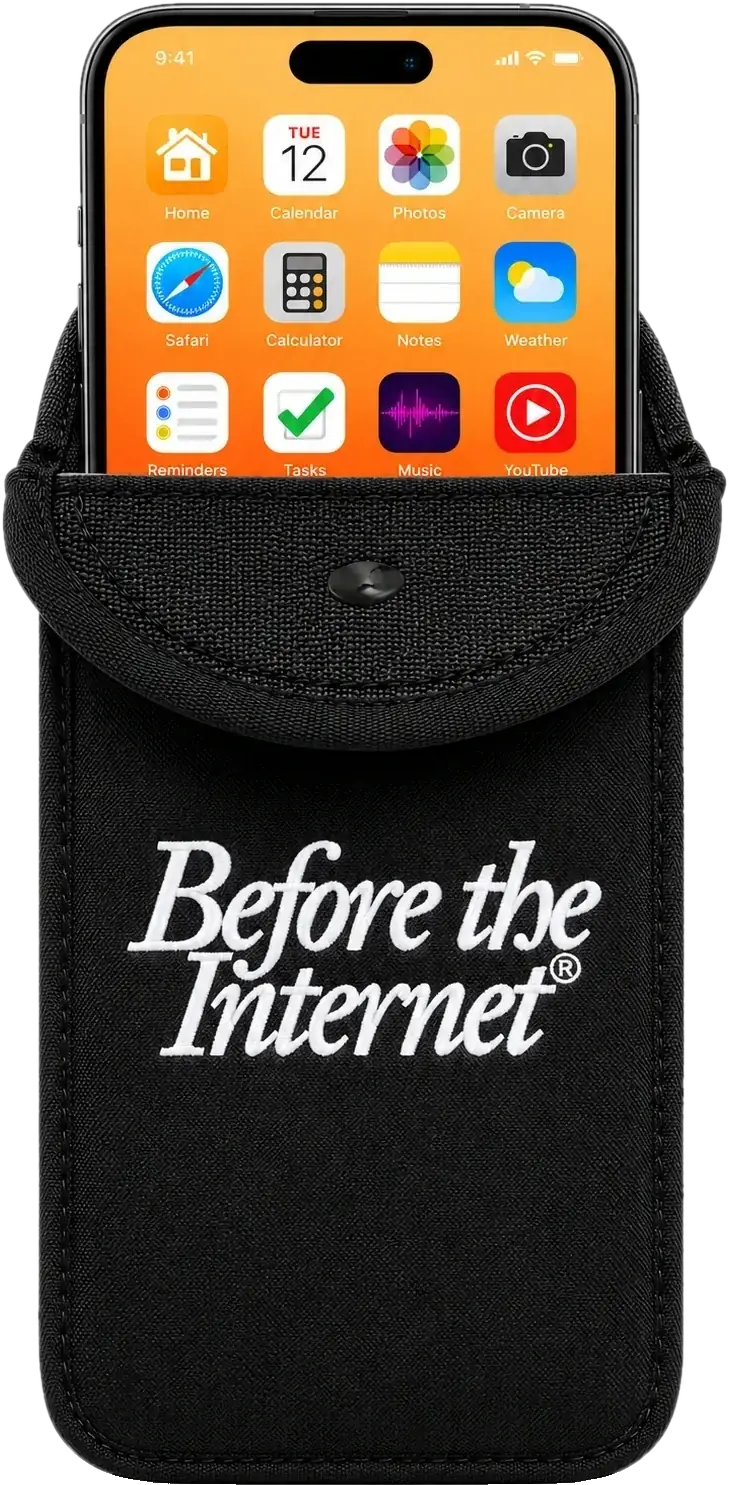
A lockable phone pouch is a fabric sleeve with a magnetic lock. Students lock their own phone inside at the start of the day, keep it in their bag, and unlock it at an unlocking base when school ends. Before The Internet sells lockable phone pouches and unlocking bases to schools as a one-time purchase, with no subscription.
| Option | How it works | Best for | Main drawback |
|---|---|---|---|
| Lockable phone pouches | Student locks own phone in a pouch all day; unlocks at a base on exit | Whole-day rules with low staff effort | Needs enough unlocking bases; some pouch damage |
| Lockers or collection box | School holds phones until the end of the day | Small schools with spare space | Queues, storage space, lost-phone disputes |
| "Not seen, not heard" | Phone stays in the bag, switched off | Schools starting out, no budget | Relies on staff spotting phones; leaks into lessons |
What is a lockable phone pouch and how does it work?
A lockable phone pouch is a padded fabric sleeve with a magnetic locking pin. A student puts the phone inside and presses the pouch closed, and it stays locked until it is held against an unlocking base. Unlike a locker or a collection box, the student keeps the pouch, and the phone stays with them.
The daily routine is short:
- Arrival. Students switch phones to silent, place them in their pouches and lock them, usually at the gate or in registration.
- The school day. The locked pouch goes in a bag or pocket. The phone can still receive calls and messages but can't be used.
- Dismissal. Students tap the pouch on an unlocking base, usually mounted at exits or held by staff, and take the phone out.
How a Before The Internet pouch works
1. Lock
Students lock their own phone in their pouch at the gate or in registration.
2. Carry
The sealed pouch stays in their bag all day. Calls and messages still arrive.
3. Unlock
At the end of the day, students tap the pouch on an unlocking base by the exit.
As the Irish Times explained when Ireland began funding them, the appeal is that schools never have to take custody of thousands of expensive devices. That removes the liability, storage and handover queues that come with locker or box systems. For a step-by-step version, see how pouches work in practice.
Before The Internet's lockable phone pouches follow this model: one pouch per student, unlocking bases at the exits, and a routine that takes a minute at each end of the day.
A phone rule only works if it still holds at 10:15 on a Tuesday in February, not just on the first day. A lockable phone pouch takes the argument out of every lesson. The phone stays with the student, but it is off the table until the final bell.
Which countries ban phones in schools in 2026?
Phone restrictions are now normal policy in most of the English-speaking world. They differ mainly in two ways: whether the rule covers the whole day or only lessons, and whether the government says how phones must be stored. For Scotland, Wales, Northern Ireland and continental Europe, see our country-by-country list of school phone bans.
England
The Department for Education's guidance was first published in February 2024, updated in January 2026, and put on a statutory footing on 29 June 2026, with schools expected to follow it from 1 September 2026. Even before that, restriction was close to universal. The Children's Commissioner's 2025 survey of about 19,000 schools and colleges found that 90% of secondary schools and 99.8% of primaries already restricted phones in some way. But "restricted" often meant pupils kept phones on them as long as they weren't seen or heard. That is the gap pouches are designed to close. Our guide to England's school phone ban covers what the statutory guidance means for your policy.
In November 2026 the government went further, announcing that phones should be inaccessible for the whole school day from September 2027.
Children should not be using smartphones at any point during the school day, full stop.
Ireland
Ireland is the clearest example of a government paying for storage. Circular 0045/2025 requires post-primary schools to restrict access to phones during the school day, including breaks. Circular 0046/2025 funded "secure mobile phone storage solutions", with pouches and locked boxes named explicitly, at €25 per student.
Take-up was lower than the budget allowed. When the scheme closed on 28 November 2025, RTÉ reported that just under €6.5m had been paid to 472 schools and almost €2.5m of the €9m was unspent. A further 190 eligible schools did not apply.
Ireland's phone storage grant (€ millions)
Post-primary schools, scheme closed 28 Nov 2025
Source: RTÉ News, December 2025.
Canada
Canadian provinces moved together in 2024. Global News reported that Ontario, Nova Scotia, New Brunswick, British Columbia and Alberta all introduced restrictions for fall 2024. Quebec had restricted classroom use from January 2024. The rules vary: Ontario requires phones to be silent and out of view in class, while British Columbia's rule is "bell-to-bell". Our province-by-province guide for Canada tracks the details.
United States
According to Ballotpedia data summarised by the Kansas Health Institute, 44 states plus Washington, D.C. had laws or policies on K-12 phone use as of June 2026. Several, including New York and Texas, restrict phones from bell to bell rather than only during lessons. See which US states have banned phones in schools for the full list.
Do phone pouches work? What the research says
Pouches reliably reduce phone use during the school day. The evidence that they raise grades is weak. Wellbeing dipped slightly in year one and improved after that. School leaders should go in with those expectations.
The large US pouch study
The most relevant study is an NBER working paper by Hunt Allcott and colleagues, The Effects of School Phone Bans: National Evidence from Lockable Pouches (April 2026, revised September 2026). It is the first national-scale study of pouches specifically. The authors found that pouches "substantially reduce" in-school phone use, but that average test-score effects are "consistently close to zero". High schools saw modest gains and middle schools small losses. In the first year, discipline incidents rose and student wellbeing suggestively fell. In later years the discipline effect faded and wellbeing effects turned positive.
Two caveats matter. The paper has not yet been peer-reviewed. And it was built on sales and administrative data from Yondr, a pouch manufacturer, which the authors thank for its partnership. Many comparison schools also already had softer phone rules, so the study measures pouches against "some restriction", not against no restriction at all.
The UK and Ireland evidence
The only UK pouch-specific evaluation we found is a King's College London pilot in nine Northern Ireland secondary schools in 2025-26, reported by Phys.org in August 2026. Pouches were associated with less smartphone use, fewer classroom disruptions and better interaction between pupils, with some reduction in self-reported anxiety and depression. The researchers also recorded the practical problems: too few unlocking points, damaged pouches and enforcement that varied from teacher to teacher. Adherence was higher among younger pupils.
A larger English study points the other way. The University of Birmingham's SMART Schools study, published in The Lancet Regional Health – Europe in 2025, compared 1,227 pupils in 20 restrictive and 10 permissive secondary schools. Restrictive schools cut in-school phone use by about 40 minutes a day. The study found no difference in wellbeing, sleep, attainment or behaviour, because total daily use barely changed. Most "restrictive" schools in that study did not use locked pouches, but the lesson carries over: a school-day rule does not fix evenings.
Other studies worth knowing
- Norway. Sara Abrahamsson's study of Norwegian school bans found higher GPAs and fewer mental-health visits for girls, and less bullying for both boys and girls, with the largest gains for girls from low-income families.
- Florida. David Figlio and Umut Özek's NBER study of a large Florida district found suspensions rose in the first year of a ban, then faded. Test scores improved in year two, largely because unexcused absences fell.
The Hechinger Report's overview of the global research reaches a similar overall view. Bans work best where they are actually enforced, and the gains show up more in attention and behaviour than in exam results.
The case for pouches does not rest only on test scores. Phones take up real time in the school day. Common Sense Media's Constant Companion study tracked about 200 US 11-to-17-year-olds and found a median of 43 minutes of phone use during school hours. School leaders also see the damage. In the US National Center for Education Statistics' School Pulse Panel, most public school leaders said phones hurt students' attention and mental health.
School leaders who say phones hurt students
US public schools, December 2024
Source: NCES School Pulse Panel, 2025-02-19.
For the longer version of this evidence, read why schools ban phones and what the evidence actually says.
Are phone pouches better than lockers or "not seen, not heard"?
Each storage model trades enforcement strength against cost and staff time. This is how the three most common approaches compare:
| Question | Lockable pouches | Lockers or lockboxes | "Not seen, not heard" |
|---|---|---|---|
| Who holds the phone | The student, locked | The school | The student, unlocked |
| Enforcement | Physical lock; staff check pouches are sealed | Physical separation; handover at each end of the day | Relies on staff spotting phones |
| School liability for devices | Low | High: the school holds the devices | Low |
| Time cost | Lock at arrival, unlock at exit | Collection and return queues | None up front, constant policing |
| Upfront cost | Per-student pouch plus unlocking bases | Fixed storage per room or year group | Near zero |
| Main weakness | Decoy phones, damaged pouches | Space, queues, lost-device disputes | Phones leak back into lessons |
"Not seen, not heard" policies cost nothing up front, and for that reason they are where most schools started. Moving to pouches mainly buys a rule that teachers no longer have to enforce one phone at a time.
How much do phone pouches cost for a school?
In the US, reported pouch costs cluster around $25 to $30 per student. Yondr's chief executive told NBC News that its price is about $30 per student, covering the pouch, training and start-up support. At district scale those numbers add up. NBC reported that Los Angeles Unified spent $5.2m in 2023-24, and CBS News reported that Cincinnati spent $500,000 on pouches for grades 7 to 12.
Ireland's €25-per-student grant was set at a similar level. The Irish scheme also allowed claims for replacement pouches of up to 20% of enrolment, which is a useful planning figure for breakage and loss.
When you build a budget, cost these items separately:
- Pouches for every student, plus spares for new intake and replacements.
- Unlocking bases, enough to avoid queues at dismissal.
- Staff time for launch, training and the first term of enforcement.
- A replacement policy: who pays when a pouch is lost or damaged.
Whether a supplier charges once or every year changes the numbers a lot. Before The Internet sells pouches to schools outright: the school pays once and owns the pouches and unlocking bases, with no annual licence. Our 2026 school phone pouch price guide works through the budget line by line.
What goes wrong with phone pouches, and how can schools prevent it?
Most pouch programmes that fail do so for operational reasons, not because the idea is wrong. US news reports and the Northern Ireland pilot describe the same problems again and again:
- Queues at unlocking points. CBS News reported long lines at dismissal in Yonkers, New York, which bought pouches for about 11,000 students. Fix: install more bases than seems necessary and spread them across exits.
- Decoy and second phones. Some students hand in an old phone and keep their real one. Fix: spot checks and a clear consequence written into the policy before launch.
- Broken or forced pouches. Students have cut pouches, banged them open or used magnets bought online, CBS News reported. In a Newark, New Jersey pilot, Chalkbeat reported only "one or two instances" of opened or stolen pouches, with fees of $5 up to $20 for a replacement. Fix: publish the replacement charge in advance.
- Inconsistent enforcement. This was the main weakness the Northern Ireland researchers found. Fix: senior leaders run the first weeks visibly, and every member of staff applies the same rule.
- Programmes dropped after a year. NBC reported that at least one California middle school abandoned pouches after a single year. A first-year rise in discipline, which the NBER study also found, can look like failure if nobody warned staff and parents to expect it.
How do parents reach students in an emergency?
Parents' most common objection is "How will I reach my child in an emergency?" The answer to put in your policy is that emergency contact goes through the school, as it did before smartphones. A locked pouch does not block calls from arriving. Each school decides when phones may be unlocked.
Good policies spell this out in writing. New Jersey, for example, requires district phone policies to include emergency-use guidelines, as Chalkbeat noted in its report on Newark's pilot. Ireland's circular likewise expects schools to set out exemptions, such as medical needs, in their own policies. In practice, cover these points:
- Students who need a phone for medical reasons, such as glucose monitoring.
- How parents contact the office during the day, and how quickly messages reach the student.
- Who unlocks pouches during an evacuation or lockdown, and when.
Our bell-to-bell school phone policy template includes wording for each of these.
How should a school roll out phone pouches?
Rollout quality decides whether pouches work. In order:
- Agree the scope. Decide whether the rule covers lessons only or the whole day, including break and lunch, and write it down.
- Consult early. Brief governors or the board, staff, parents and student leaders before you buy anything. Share the evidence honestly, including that grades may not move.
- Write the exceptions. Medical needs, emergencies, trips and after-school activities.
- Size the hardware. Order one pouch per student, spares for breakage, and enough unlocking bases for a fast dismissal.
- Launch with a clear start date. Have senior staff visible at gates for the first two weeks.
- Expect a rough first term. Track incidents, queues and damage, and tell staff in advance that discipline often rises before it settles.
- Review after a term. Ask staff and students what changed, and adjust the number of unlocking points or the replacement policy.
How to roll out phone pouches in a school expands each step, and the phone-free schools toolkit has the documents governors usually ask for.
Which option should your school choose?
- Choose lockable phone pouches if you want a whole-day rule that holds without staff policing every lesson, you don't want the school responsible for storing hundreds of phones, and students need their phone on the way home. This is what Before The Internet supplies.
- Choose lockers or a collection box if your school is small, has spare space near the entrance, and can staff a handover at both ends of the day.
- Stay with "not seen, not heard" only if your rules allow it and staff report that it is holding. In England, statutory guidance now expects a phone-free school day, and most schools find this approach leaks back into lessons.
Frequently asked questions
Do phone pouches improve grades?
Not much, on average. The largest pouch study found test-score effects "consistently close to zero" across schools, with small gains in high schools. Older studies of strictly enforced bans, such as Beland and Murphy's study of English schools, found larger gains for lower-achieving pupils. Pouches change attention and behaviour more reliably than exam results.
Can students still get calls in a locked pouch?
Yes. A locked pouch blocks use, not signal, so calls and messages still arrive. The student just can't answer until the pouch is unlocked. Parents should contact the school office during the day, as the school's policy sets out.
Can students break or get around phone pouches?
Some will try, by forcing the pouch, using a magnet or handing in a decoy phone. In Newark's pilot, which published replacement fees, Chalkbeat reported only one or two opened or stolen pouches. Spot checks and consistent enforcement can help keep workarounds rare.
Is England's school phone ban a legal requirement?
The Department for Education's mobile phone guidance became statutory on 29 June 2026, and schools are expected to follow it from September 2026. The guidance sets the expectation of a phone-free school day. It does not require a particular storage method, so pouches are one option among several.
What is Before The Internet?
Before The Internet is a Toronto-based supplier of lockable phone pouches to schools and events in the UK, Ireland, Europe and Canada, and it ships to schools in any country. It sells pouches and unlocking bases to schools as a one-time purchase, in two styles: the Fully Sealed pouch for strict bell-to-bell policies and the Semi-Frosted pouch, which covers both cameras but lets a student see an emergency alert. It rents pouches for events, and the company publishes free guides, a policy template and a phone-free schools toolkit for school leaders.
Where can schools buy lockable phone pouches?
Several companies supply them, including Yondr in the US and Before The Internet in Canada, the UK, Ireland and Europe. Compare written quotes on the same basis: the number of pouches, the number of unlocking bases, replacement costs and contract length. Before The Internet will beat any like-for-like written quote dated within the last 30 days.
How much do lockable phone pouches cost per student?
US reports put pouch programmes at roughly $25 to $30 per student including support, and Ireland funded storage at €25 per student. Total cost depends on the number of unlocking bases and spares, and on whether the supplier charges once or every year.
The bottom line
Lockable pouches are a reliable way to turn a phone policy that relies on goodwill into one that holds, because the lock does the enforcing instead of individual teachers. The evidence says they will cut phone use. It does not promise better exam results, and the first term is often the hardest. Schools that consult early, budget for spares and unlocking points, and enforce consistently get the attention and behaviour gains. Schools that skip those steps tend to give up after a year.
If you're planning a phone-free school day for 2027, Before The Internet can quote for pouches for your school: a one-time purchase, with a reply from a person within 24 hours.
About the authors: Before The Internet is a Toronto-based supplier of lockable phone pouches to schools and events in the UK, Ireland, Europe and Canada. Our guides are researched by the team from primary sources (government guidance and research papers) and established news outlets. We correct errors when readers point them out.
Sources
- Department for Education, Mobile phones in schools, updated January 2026; statutory from 29 June 2026.
- Children's Commissioner for England, School phone policies in England, April 2025.
- Department of Education and Youth (Ireland), Circular 0046/2025, June 2025.
- RTÉ News, phone storage funding report, December 2025.
- Allcott et al., NBER Working Paper 35132, revised September 2026.
- Goodyear et al., SMART Schools study, via the University of Birmingham, February 2025.
- King's College London Northern Ireland pilot, via Phys.org, 27 August 2026.
- NCES, School Pulse Panel, February 2025.
- Beland and Murphy, "Ill Communication: Technology, distraction & student performance", Labour Economics 41, 2016.
- Common Sense Media, Constant Companion, September 2023.
- NBC News, school spending on pouches, 12 September 2025; CBS News, Yondr pouches in schools, 6 September 2025.
Planning a phone-free school?
Send your student numbers and target start date. A person replies within 24 hours with a real figure for your budget, and we ship worldwide.